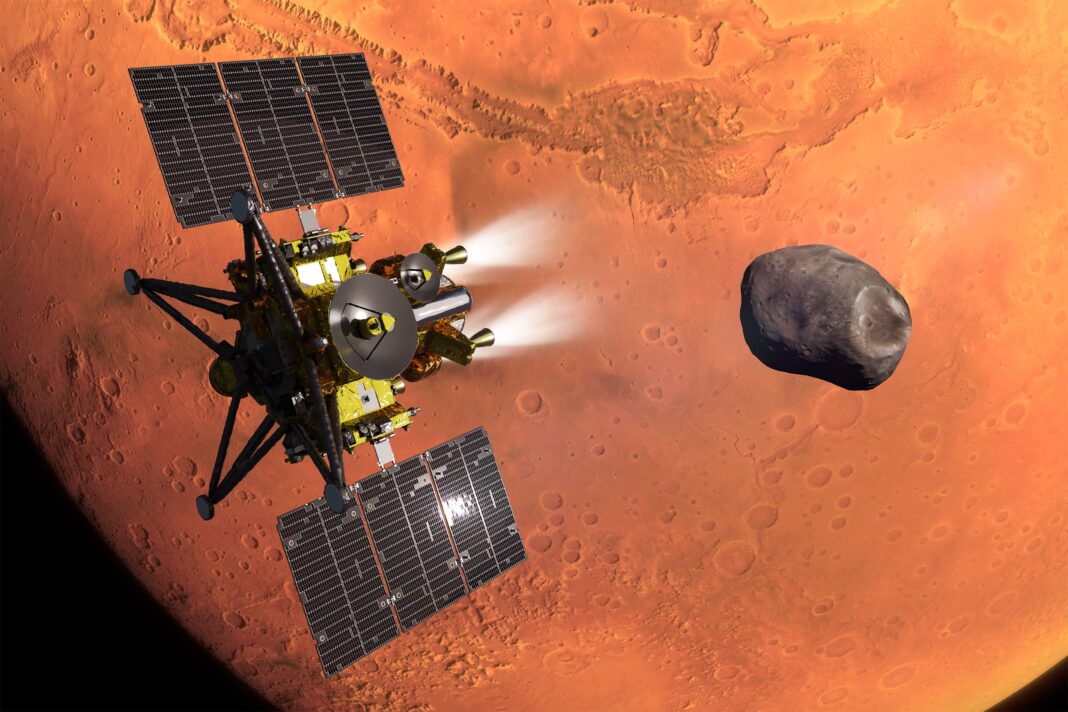
Japan’s space agency is preparing a mission to bring samples from a Martian moon back to Earth. The spacecraft is called MMX, short for Martian Moons eXploration. It targets Phobos, the larger of Mars’ two moons.
The Japan Aerospace Exploration Agency, or JAXA, leads the project with international partners. MMX aims to land on Phobos and collect surface material. A successful return would mark the first samples ever retrieved from a Martian moon.
Phobos is a small, irregularly shaped body orbiting close to Mars. Scientists are unsure whether it formed from debris around Mars or was captured from elsewhere. Samples could settle that debate by revealing the moon’s origin.
The mission plan calls for a brief touchdown on Phobos. A robotic sampler will gather soil and store it in a sealed capsule. The spacecraft will then leave the moon and head back toward Earth.
The return capsule is designed to reenter Earth’s atmosphere and land for recovery. Scientists will then examine the material in laboratories worldwide. The samples may hold clues about the early solar system and the history of Mars.
MMX also carries instruments to study Phobos from orbit before landing. Cameras and spectrometers will map the surface and help select a safe sampling site. This survey phase reduces risk and improves the odds of a clean collection.
The mission faces technical hurdles, including precise navigation in Mars’ gravity field. Timing is tight, and the sampling operation must work on the first attempt. JAXA has tested key technologies on earlier asteroid missions.
If MMX succeeds, it would add to a growing record of sample-return missions. Japan’s Hayabusa2 already brought asteroid material to Earth in 2020. MMX would push that capability to a new destination and a new set of scientific questions.