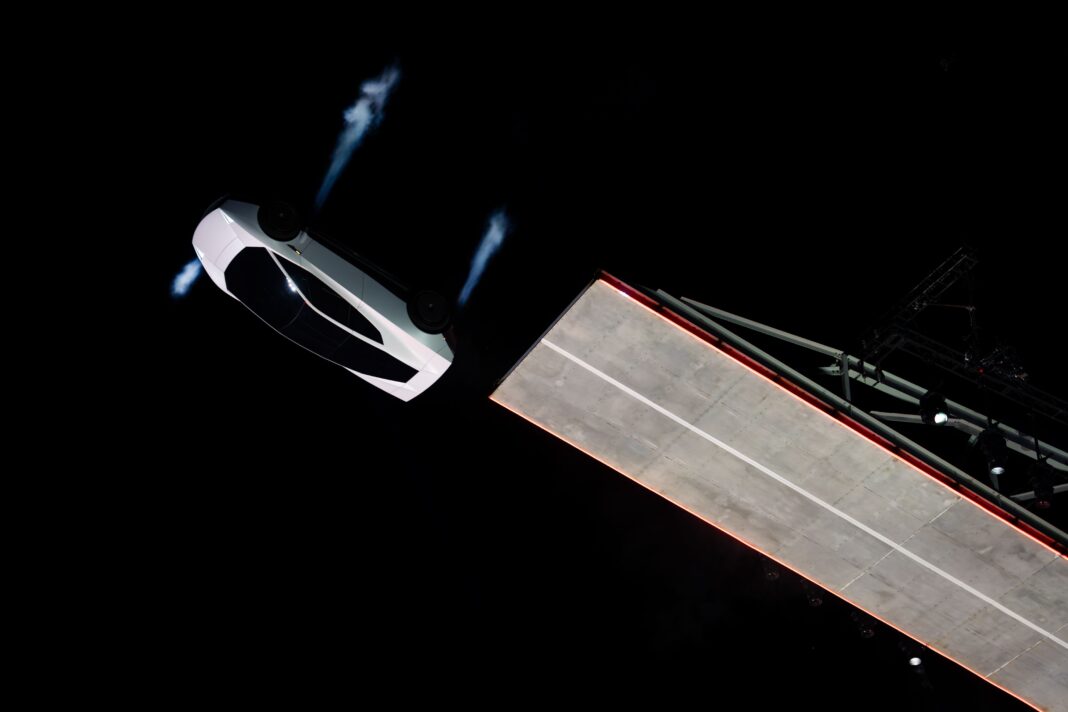
Tesla’s flying Roadster concept relies on basic physics principles rather than magic. The car uses powerful fans to generate downward force. This force pushes the vehicle off the ground.
Friction plays a central role in the car’s ability to glide and stick to surfaces. Tires and aerodynamic surfaces create grip through controlled contact. Managing that grip determines whether the car hops or holds steady.
The Roadster’s hopping motion comes from a burst of upward force. Fans or compressed gas push against the ground beneath the vehicle. The car rises briefly before gravity pulls it back down.
Gliding requires a different balance of forces. The vehicle must generate enough lift to overcome its own weight. Stability systems then keep the car level during flight.
Sticking upside down demands the most extreme application of force. Downward thrust must exceed gravity at all times. Without continuous force, the car would simply fall.
The physics involved are well understood and widely used in other fields. Drones and hovercraft apply similar principles every day. The challenge lies in scaling them to a full-sized car.
Elon Musk’s concept pushes these ideas into new territory. The engineering hurdles remain significant, but the underlying science is sound. Friction and force will decide whether the Roadster ever truly flies.