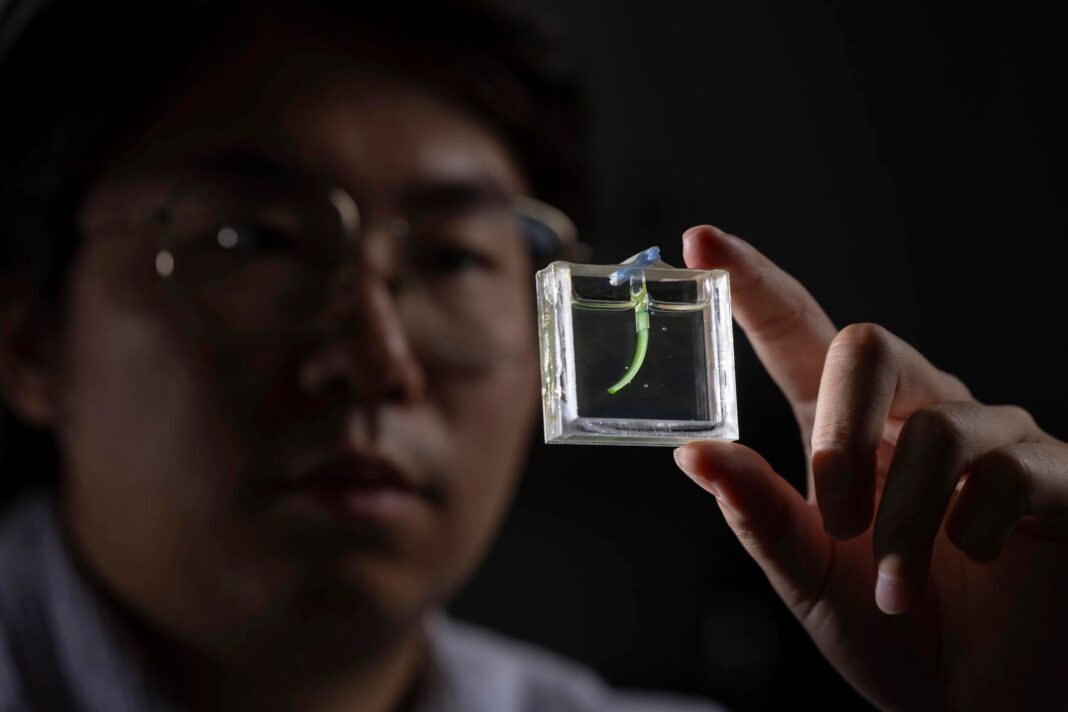
Roboticists have developed flexible robotic arms that draw their power from algae. The devices rely on the organism’s photosynthetic capabilities to generate movement. This approach points to a future where robots could run on light rather than batteries.
The arms are built from soft, pliable materials instead of rigid metal joints. Algae embedded in the structure produce oxygen when exposed to light. That gas builds pressure inside the arms and drives them to bend and flex.
Photosynthesis serves as the engine behind every motion. When light hits the algae, oxygen output rises and inflates internal channels. Shutting off the light reverses the process, letting the arms relax.
Soft robotics has long struggled with bulky power sources. Compressors, pumps, and battery packs often limit where these machines can go. Algae offers a living, self-sustaining alternative that removes much of that hardware.
The technology remains experimental and faces real hurdles. Response times are slow compared to motor-driven systems, and the algae need care to stay alive. Scaling the approach for practical tasks will take further work.
Researchers say the work could lead to robots that operate in water or other sensitive environments. Light-powered movement would suit settings where electricity or compressed air is impractical. The softness of the arms also makes them safer around people.
The project adds to a growing push toward biohybrid machines that blend living organisms with engineered parts. Algae-based actuators could eventually support environmental sensing or delicate handling tasks. For now, the arms show that biology can serve as a viable power source for movement.