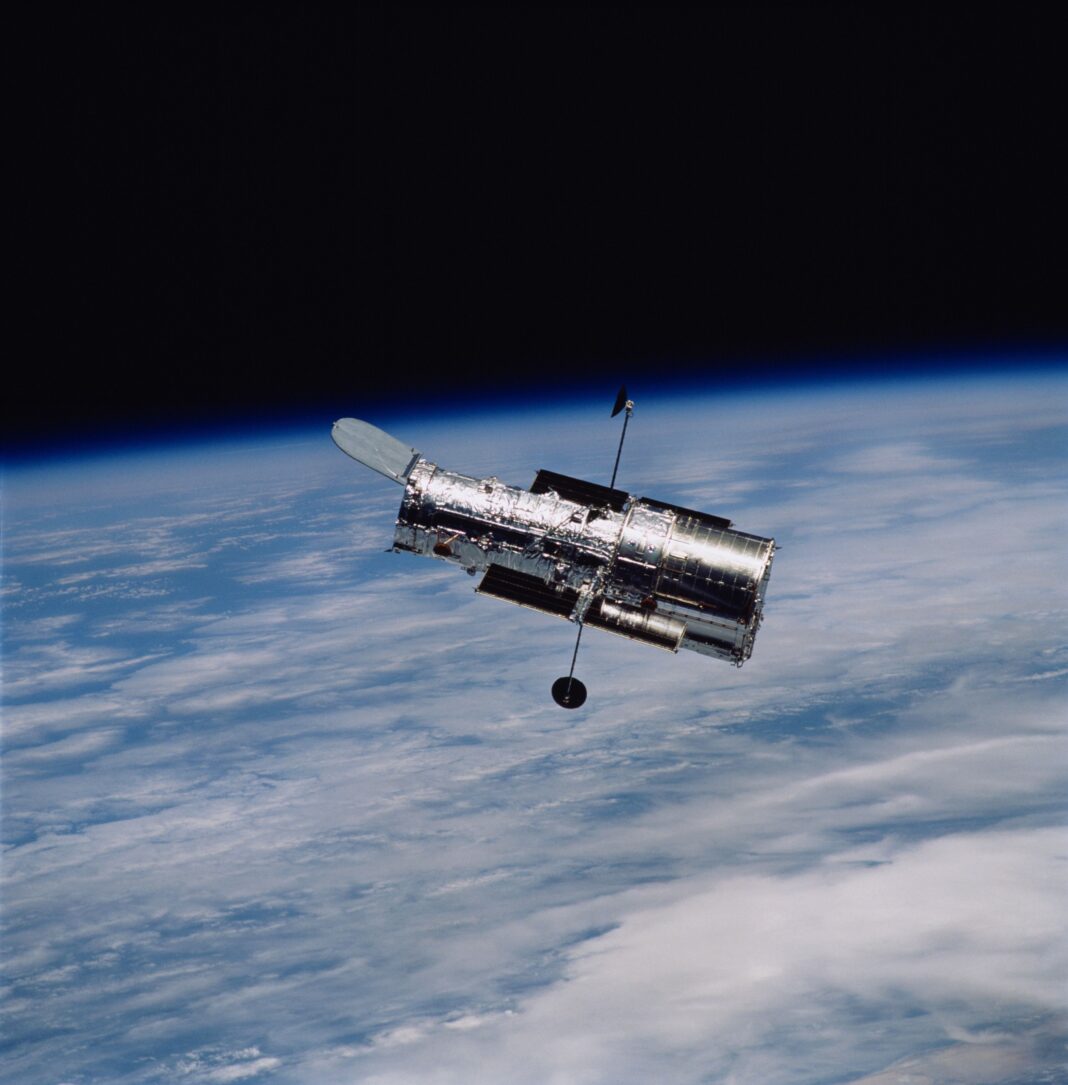
The Hubble Space Telescope is gradually losing altitude and could reenter Earth’s atmosphere by 2034. Several onboard malfunctions have compounded the problem in recent years. NASA is now asking commercial space companies for proposals to extend the telescope’s lifespan.
Hubble has circled Earth for more than three decades and transformed our understanding of the universe. Its orbit continues to decay as residual atmospheric drag slowly pulls it downward. Without intervention, the observatory will eventually burn up in the atmosphere.
The telescope has faced a series of technical failures in recent years. Gyroscope issues and computer glitches have interrupted observations multiple times. Each malfunction leaves the aging spacecraft more vulnerable to further problems.
NASA issued a formal request for information to private space companies in 2024. The agency wants ideas for boosting Hubble to a higher, more stable orbit. A commercial mission could add years of productive science.
The request follows a 2022 study with SpaceX on whether a Crew Dragon capsule could service Hubble. That study focused on reboosting the telescope without a docking port. Engineers concluded the concept was technically feasible but faced significant challenges.
Any servicing mission would require precise rendezvous and capture of the school-bus-sized observatory. Hubble lacks the docking hardware that the International Space Station uses. A visiting vehicle would need to grapple the telescope robotically or attach a new propulsion module.
NASA has stressed that no mission has been approved and that Hubble remains scientifically productive. The agency is gathering cost and feasibility data from industry partners. A decision on whether to proceed could come after the proposals are reviewed.
Hubble’s scientific legacy includes measurements of the universe’s expansion rate and iconic images of distant galaxies. Extending its life would preserve a unique capability for ultraviolet and visible-light astronomy. NASA hopes to keep the telescope operating alongside the newer James Webb Space Telescope.