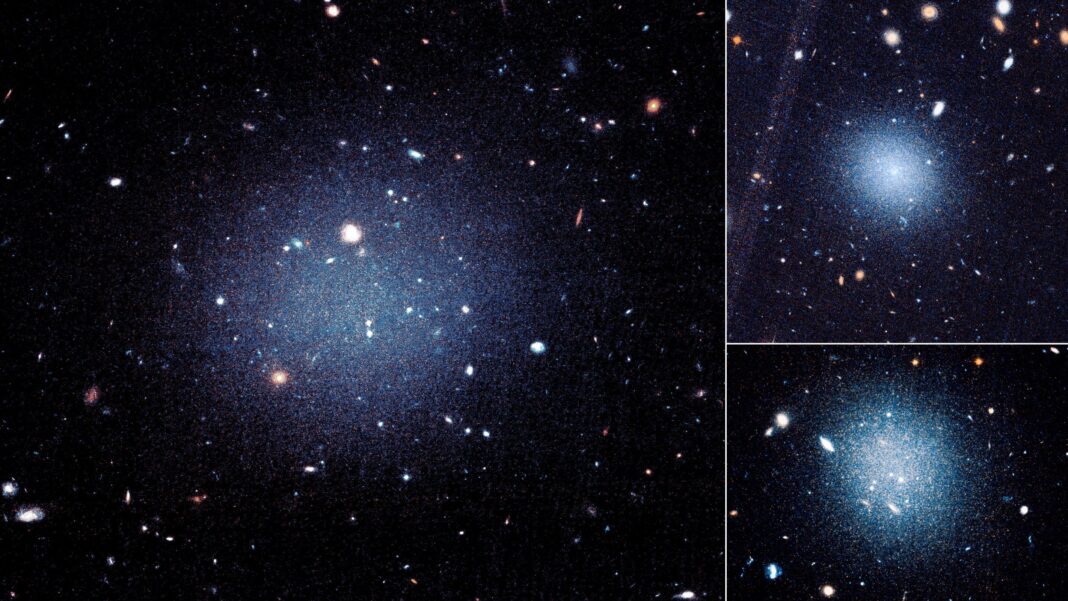
Astronomers have found galaxies that appear to be missing their dark matter entirely. The discovery challenges assumptions about how galaxies form and hold themselves together. Two separate teams reported the findings in prestigious scientific journals.
Dark matter is an invisible substance that makes up most of the mass in the universe. It provides the gravitational glue that keeps galaxies from flying apart. Without it, ordinary matter alone cannot account for observed galactic motion.
The newly studied galaxies are faint and diffuse, earning them the nickname “ghostly.” They contain far less dark matter than models predict. Researchers detected this by measuring how fast their stars move.
These galaxies likely lost their dark matter through violent collisions with larger neighbors. The encounters stripped away the invisible halos while leaving the stars largely intact. Computer simulations support this ejection scenario.
Paradoxically, the absence of dark matter offers strong evidence that it exists. If galaxies can be missing it, then it must be a real, separable component of matter. The finding rules out theories that modify gravity instead of invoking dark matter.
The results could reshape how scientists search for dark matter in other galaxies. Future surveys may identify more objects with unusually low dark matter fractions. Each new example helps refine models of galactic evolution.
The studies appear in the journals Nature and The Astrophysical Journal. Astronomers caution that more observations are needed to confirm the results. Still, the ghostly galaxies already stand as some of the most compelling evidence yet for dark matter.