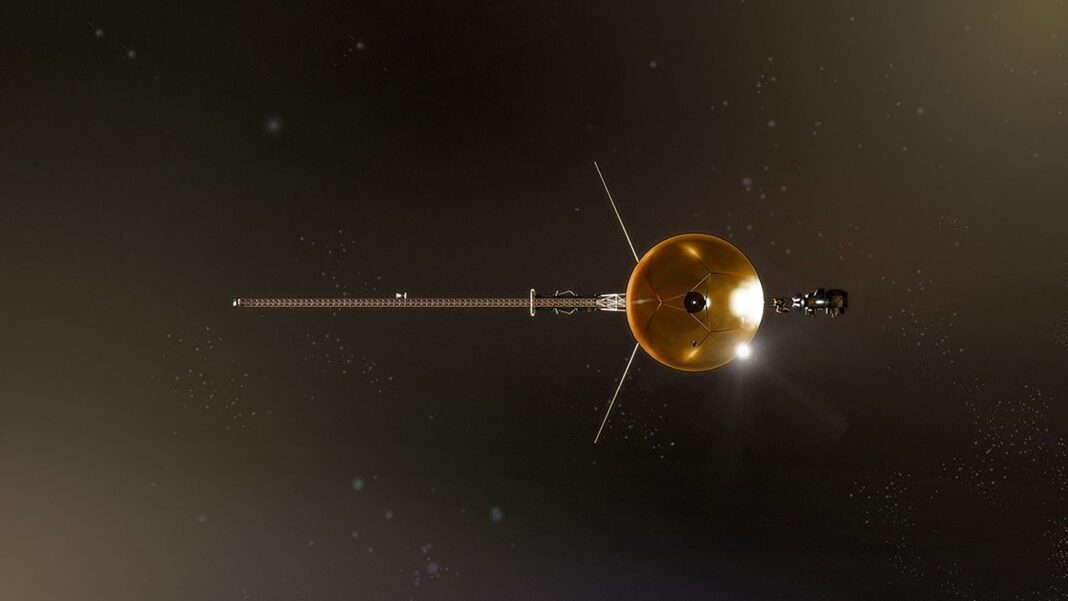
NASA’s Voyager 1 spacecraft has crossed a distance threshold that resets how far human-made objects have traveled. The probe is now more than one light-day from Earth. That means its signals take over 24 hours to reach receivers on the ground.
A light-day is the distance light covers in a single Earth day. Light moves at about 186,000 miles per second. Over 24 hours, that adds up to roughly 16 billion miles. Voyager 1 has now passed that marker.
The spacecraft launched in 1977 on a tour of the outer planets. It flew past Jupiter and Saturn before heading toward interstellar space. It crossed the heliopause in 2012 and now travels through the interstellar medium.
Reaching a light-day reflects decades of steady outward motion. Voyager 1 moves at about 38,000 miles per hour relative to the Sun. Even at that speed, the scale of space makes progress slow. Each additional light-day takes decades to achieve.
The distance also changes how mission teams operate the craft. A command sent from Earth takes a full day to arrive. Engineers must wait another day for confirmation. Two-way communication now spans more than 48 hours.
Voyager 1 carries a finite power supply and loses about four watts each year. Instruments have been shut down one by one to conserve energy. Mission planners expect the probe to keep operating into the 2030s.
The Voyager mission has reshaped public understanding of the solar system’s edge. Its measurements revealed the shape of the heliosphere and the boundary where solar wind ends. Data from both Voyagers continue to inform models of interstellar space.
A light-day is a useful yardstick for grasping cosmic scale. The nearest star beyond the Sun sits about four light-years away. Voyager 1 would need tens of thousands of years to cover that gap. The probe’s progress remains a benchmark for human reach into deep space.