Astronomers have found new evidence supporting the existence of a long-theorized celestial object known as a black hole star. Observations from the James Webb Space Telescope have lent credibility to this unusual explanation for mysterious red spots detected in the early universe. The findings could reshape current understanding of how galaxies and black holes formed.
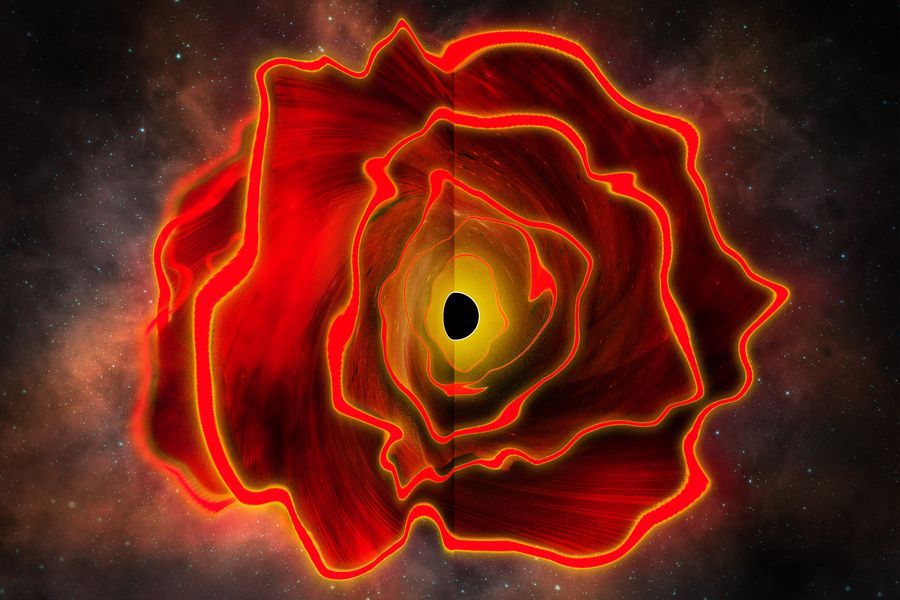
Black hole stars are a hypothetical class of objects that may have existed in the universe’s infancy. Unlike ordinary stars, which generate energy through nuclear fusion, black hole stars are thought to be powered by the gravitational energy of a central black hole. This process would have allowed them to grow to enormous sizes, potentially thousands of times the mass of the Sun.
The red spots in question have puzzled scientists since their discovery. These compact, luminous regions appear in data from the early universe, a period roughly a few hundred million years after the Big Bang. Standard models of star formation have struggled to fully explain their brightness and structure.
The new observations suggest that black hole stars could account for these anomalies. According to researchers, the energy output and spectral signatures of the red spots align more closely with predictions for black hole stars than with conventional stellar populations. This match provides a plausible, albeit exotic, explanation for what these objects are.
However, the interpretation is not without challenges. Black hole stars would have been short-lived by cosmic standards, eventually collapsing or evolving into other structures. Their existence would also require specific conditions, such as high densities of dark matter in the early universe, which remain unconfirmed.
The James Webb Space Telescope’s advanced capabilities have been instrumental in this research. Its infrared sensors can peer deeper into the cosmos than previous instruments, revealing details of distant objects that were previously out of reach. These observations have opened a new window into the universe’s earliest epochs.
Scientists caution that more data is needed before confirming the existence of black hole stars. Follow-up observations are planned to test the hypothesis further, including detailed spectral analysis and searches for similar objects in other regions of the sky. The outcome could either cement the theory or push astronomers back to the drawing board.
For now, the possibility of black hole stars marks a significant step in exploring the unknown. The findings highlight how modern telescopes are uncovering phenomena that challenge existing models. As research continues, the line between the hypothetical and the observed may continue to blur, offering a clearer picture of how the universe took shape.