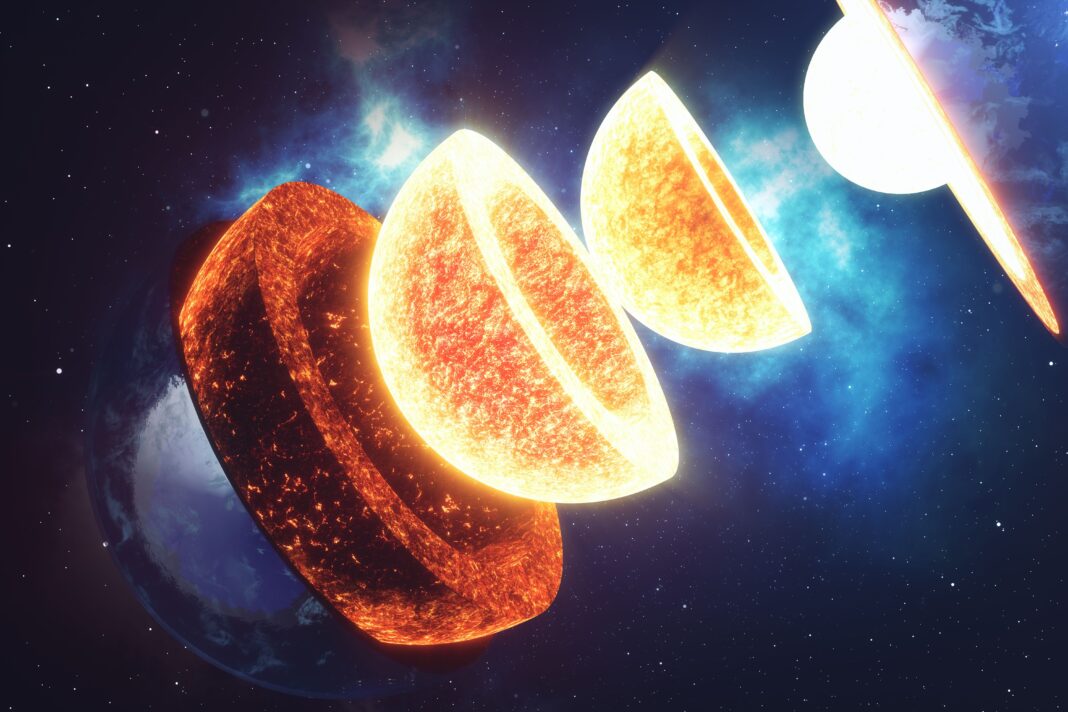
A gravitational struggle deep inside Earth is subtly changing the length of our days. The battle takes place between the planet’s solid inner core and the surrounding mantle. This ongoing tug-of-war affects how fast the Earth spins.
Scientists have long known that days are not always the same length. Forces like tides and atmospheric shifts cause tiny variations. Now, researchers point to a deeper cause involving the inner core.
The inner core is a hot, dense ball of iron and nickel. It sits roughly 3,000 miles beneath the surface. Gravity pulls it in one direction while the mantle resists.
This gravitational conflict creates a slow twisting effect. Over decades, it can speed up or slow down the planet’s rotation. The result is a change of milliseconds in a day’s duration.
The inner core grows slowly as the Earth cools. This growth releases heat and drives convection in the liquid outer core. That motion generates the planet’s magnetic field.
Researchers used seismic waves from earthquakes to track the inner core’s movement. They found it shifts slightly relative to the mantle. These shifts align with observed changes in day length.
The effect is tiny for daily life, but it matters for precise timekeeping. Atomic clocks and satellite navigation rely on exact Earth rotation data. Scientists must account for these deep forces to stay accurate.
Understanding this inner-core battle also reveals Earth’s history. It shows how the planet’s layers interact over millions of years. Future studies will refine how gravity shapes our planet’s spin.