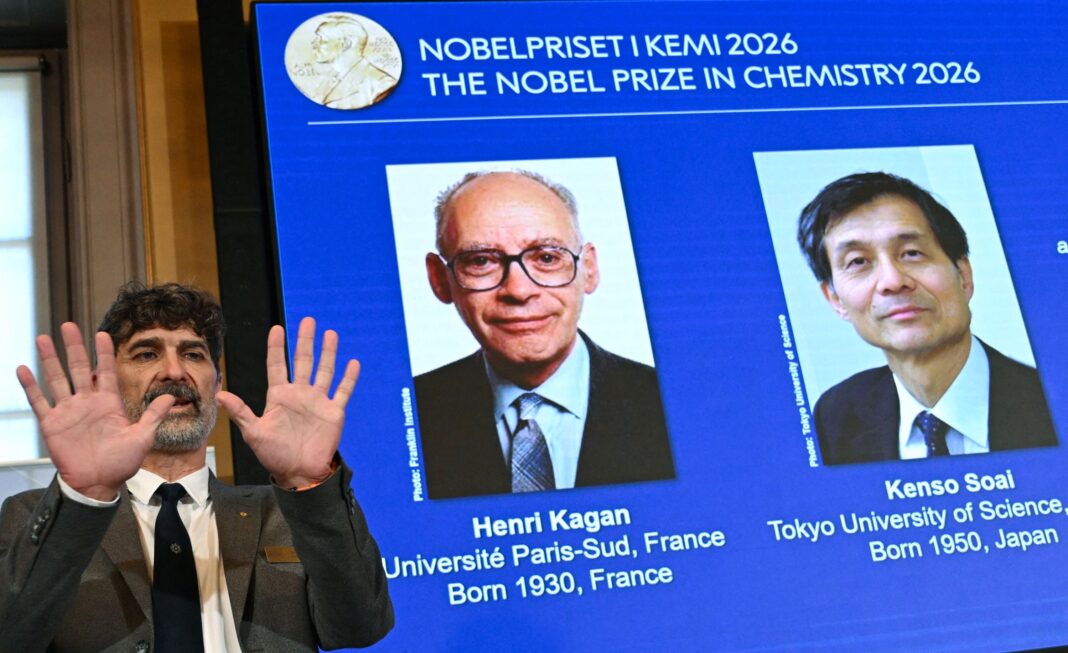
The 2026 Nobel Prize in Chemistry has been awarded to Henri Kagan and Kensō Soai for solving a long-standing mystery about why life is asymmetric.
Living organisms overwhelmingly use only one of two possible mirror-image forms of molecules, a property known as chirality.
Kagan and Soai designed chemical reactions that produce just one of these mirror-image forms, rather than a mix of both.
Their work addressed a fundamental puzzle: many molecules exist in two versions that are mirror images, like left and right hands.
In living systems, however, one version typically dominates. This asymmetry is essential for biological function.
Pharmaceuticals and other biological substances often require a single mirror-image form to be effective and safe.
Producing that specific form selectively had been a major challenge for chemists before the laureates’ discoveries.
Their methods enabled precise control over which mirror-image molecule is created during synthesis.
This finding has direct applications in drug development, where the wrong mirror image can be inactive or harmful.
The prize recognizes decades of research that clarified how asymmetry arises and how it can be mimicked in the lab.
Their work continues to influence the production of medicines and other biologically active compounds.