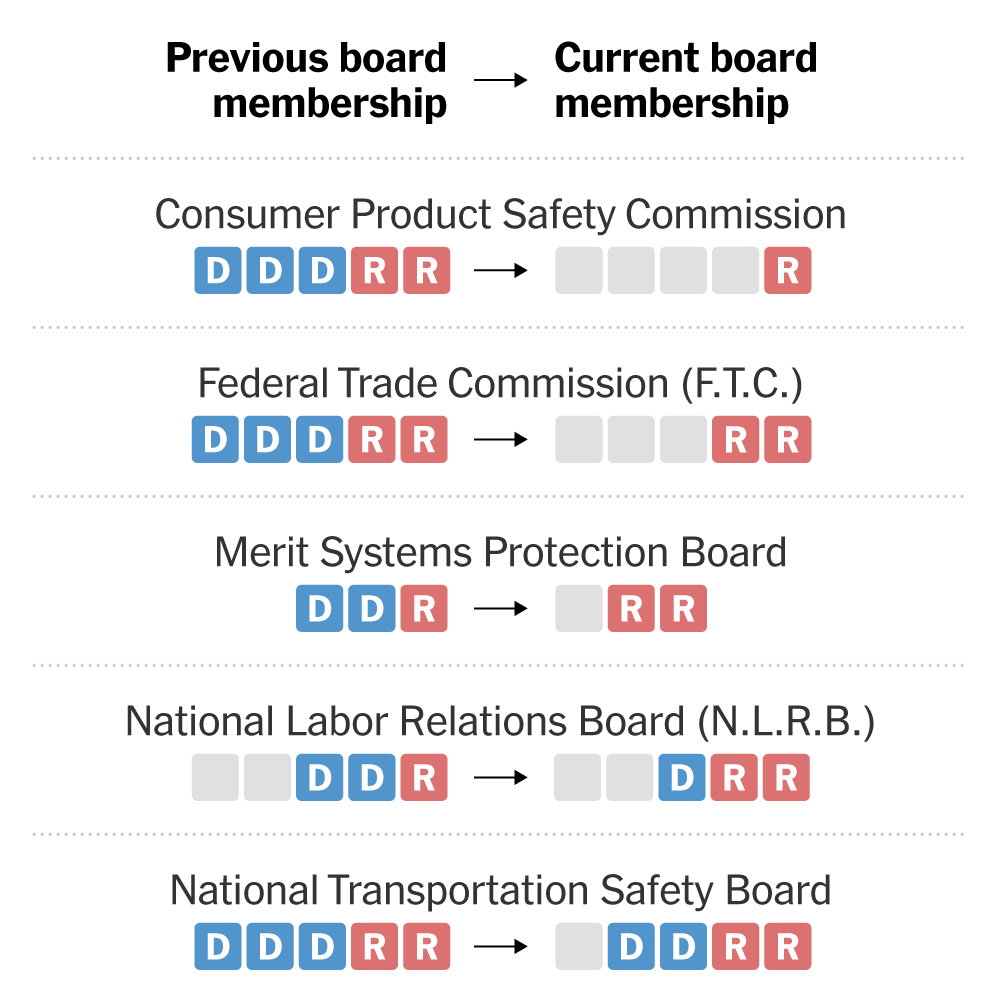
Under President Trump, the political makeup of several independent federal agencies has shifted dramatically. Even before a recent Supreme Court ruling expanded presidential authority to remove agency officials, Democratic majorities at key regulatory bodies had already been eroded.
The changes have occurred quietly across agencies like the Federal Trade Commission and the National Labor Relations Board. Trump’s appointments have systematically replaced Democratic members, often leaving Republican appointees in control.
Agency leaders traditionally served staggered terms designed to insulate them from political pressure. That structure has been weakened as Trump has moved to fill vacancies and remove holdovers from previous administrations.
Critics argue the shift threatens the independence of agencies meant to operate without direct White House influence. Supporters say the moves reflect a proper exercise of executive authority over federal regulation.
The Federal Election Commission and the Consumer Financial Protection Bureau have also seen majorities flip. This has altered enforcement priorities and rulemaking agendas across multiple sectors.
The trend accelerated after a Supreme Court decision earlier this year expanded the president’s power to fire certain agency heads. Legal experts say that ruling cleared a path for further reshaping of independent agencies.
As a result, the number of Democratic appointees on major multi-member commissions has fallen sharply. Republican appointees now hold clear majorities on six out of ten key regulatory boards.
The long-term impact on regulation remains uncertain. What is clear is that the traditional model of agency independence has been fundamentally changed under this administration.