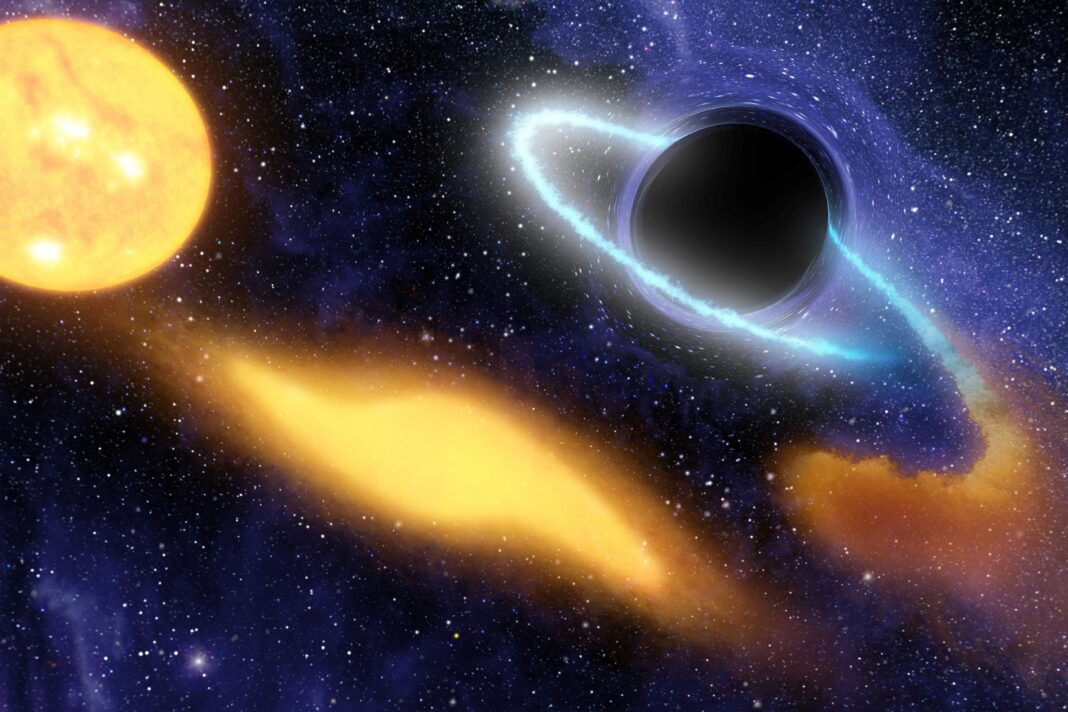
Astronomers have identified a star traveling at extraordinary speeds near the center of the Milky Way. Known as S301, it orbits close to Sagittarius A*, the supermassive black hole at our galaxy’s core. Its path brings it remarkably near the black hole’s event horizon, offering a rare opportunity for study.
The star’s proximity to Sagittarius A* is significant. It moves within a region where the black hole’s immense gravitational pull distorts spacetime. This distortion, caused by the black hole’s rotation, could provide crucial data about how such forces operate under extreme conditions.
Researchers believe S301’s orbit may reveal details about the black hole’s spin. Measuring this rotation is challenging, as it affects the surrounding spacetime in subtle ways. The star’s trajectory could serve as a natural probe, allowing scientists to track these effects with precision.
Observations of S301 have been ongoing using advanced telescopes. These instruments capture the star’s motion over time, building a detailed map of its orbital path. From this data, scientists can calculate how spacetime bends near the black hole, potentially confirming existing theories.
The findings could have broader implications for physics. Understanding how a supermassive black hole rotates helps refine models of gravitational behavior. It may also shed light on how such black holes grow and influence their galactic environments.
S301 is part of a cluster of stars orbiting Sagittarius A*, but its speed and proximity set it apart. Its future movement will be tracked closely, as even slight deviations could offer new insights. The star is not expected to fall into the black hole, but its close passes remain highly valuable.
This research is still in its early stages, with more observations planned. Each orbit of S301 provides additional data, gradually improving our understanding of the black hole’s properties. The work represents a step forward in studying some of the most extreme objects in the universe.