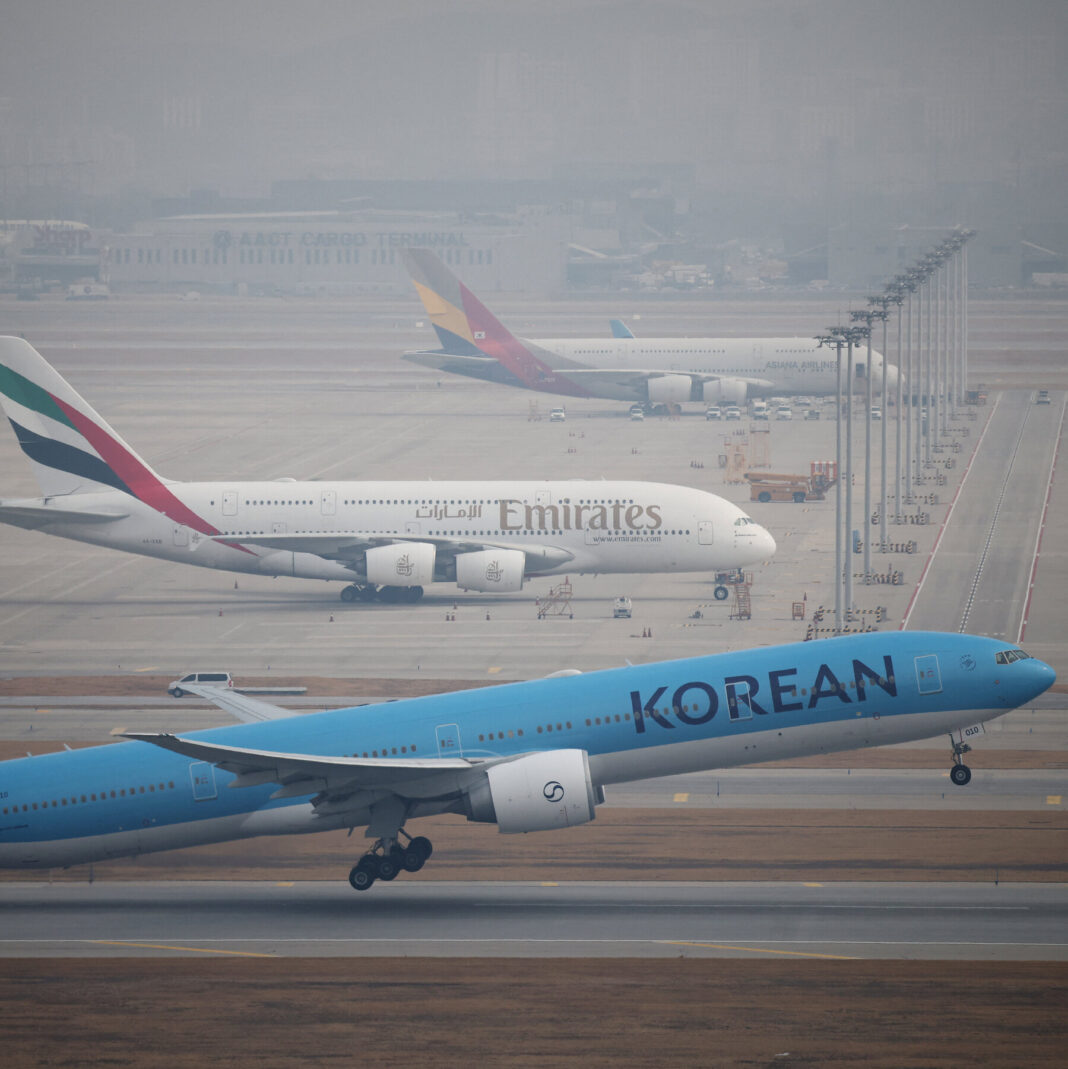
The Iran war has sharply reduced transit traffic at major Middle Eastern airports, shifting long-haul layover demand toward Asian hubs. Seoul, along with other airports in the region, is emerging as a practical alternative for carriers and passengers rerouting around conflict zones. The shift, however, may prove temporary depending on how regional security evolves.
Dubai and other Gulf airports have long served as central connection points for flights between Europe, Asia, and Africa. Their geographic position made them efficient refueling and transfer stops. But ongoing hostilities have forced airlines to avoid certain airspace, cutting into the volume of connecting passengers these hubs typically handle.
Seoul’s Incheon International Airport, already a major East Asian gateway, has gained prominence as airlines adjust flight paths. Its infrastructure supports high passenger throughput, and its location suits routes that now stretch further east. This has made it a more frequent choice for long-haul layovers that previously stopped in the Gulf.
Other Asian airports are also benefiting from the rerouting. Operators in places like Singapore, Hong Kong, and Tokyo have seen increased interest from airlines seeking stable, conflict-free transit points. These hubs offer similar connectivity advantages without the added risk of flying near active combat zones.
The shift comes with practical trade-offs for passengers. Flights via Seoul or other East Asian cities often add hours to total travel time compared to a direct Gulf stop. That means longer journeys, but for many travelers, the assurance of safer airspace outweighs the added duration.
Airlines are still evaluating how permanent these route changes might be. Some carriers have publicly committed to the new paths, while others describe them as contingency measures. The decision largely hinges on geopolitical developments, and any de-escalation could quickly restore traditional traffic flows.
For now, Seoul’s rise as a layover hub reflects a broader adaptability across the aviation industry. Airports that can quickly absorb rerouted flights and maintain smooth connections stand to gain. Whether that advantage holds depends on factors largely outside the industry’s control.
The situation underscores how global aviation remains sensitive to conflict. A single regional war can redraw transit maps overnight, benefiting hubs far from the immediate danger. Until conditions stabilize, travelers and airlines alike will keep adjusting to a new normal in long-haul routing.