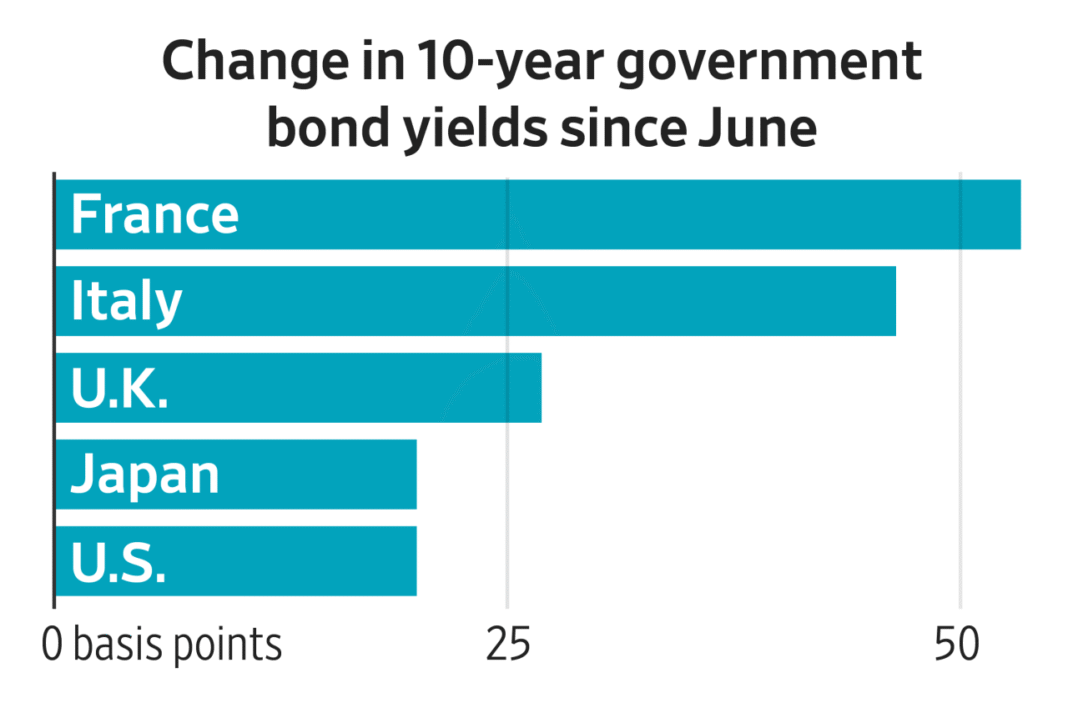
Global government bond markets are facing mounting pressure, and the turbulence extends well beyond U.S. Treasurys. Countries carrying heavy debt loads—France, Italy, the U.K., and Japan—have experienced the most severe strain in recent months. The selloff in these markets signals deeper concerns about fiscal sustainability and central bank policy paths.
Investors have grown increasingly cautious about sovereign debt from nations with stretched budgets. Higher borrowing costs in these countries reflect a reassessment of risk, as markets demand greater compensation for holding long-dated government bonds. The trend marks a shift from earlier in the year, when expectations of rate cuts fueled demand across fixed-income assets.
France has faced particular scrutiny amid political uncertainty and debates over its deficit reduction plans. Italian bonds have also suffered, with the country’s high debt-to-GDP ratio making it vulnerable to shifts in investor sentiment. The U.K. has seen similar pressure, as persistent inflation and sluggish growth complicate the government’s fiscal arithmetic.
Japan stands out as a unique case, with the Bank of Japan slowly moving away from its ultra-loose monetary policy. That transition has introduced volatility into a market long accustomed to stability, pushing yields higher and putting pressure on the government’s borrowing costs. The ripple effects have been felt across global fixed-income markets.
The divergence between the U.S. and these other nations highlights how local factors drive bond market movements. While Treasurys have faced their own challenges—including concerns about supply and inflation—the pain abroad has been more acute. For investors, this means regional differentiation is becoming increasingly important in portfolio decisions.
Market participants are now watching central bank communications closely for signs of how policy will evolve. A slower pace of rate cuts or renewed tightening could exacerbate the selloff, particularly in countries with weaker fiscal positions. The coming months are likely to test the resilience of these debt markets.
For now, the outlook remains uncertain. Borrowing costs are expected to stay elevated, and fiscal consolidation efforts will be critical in restoring investor confidence. Any misstep—whether political or economic—could trigger further turbulence in the countries already facing the heaviest pressure.