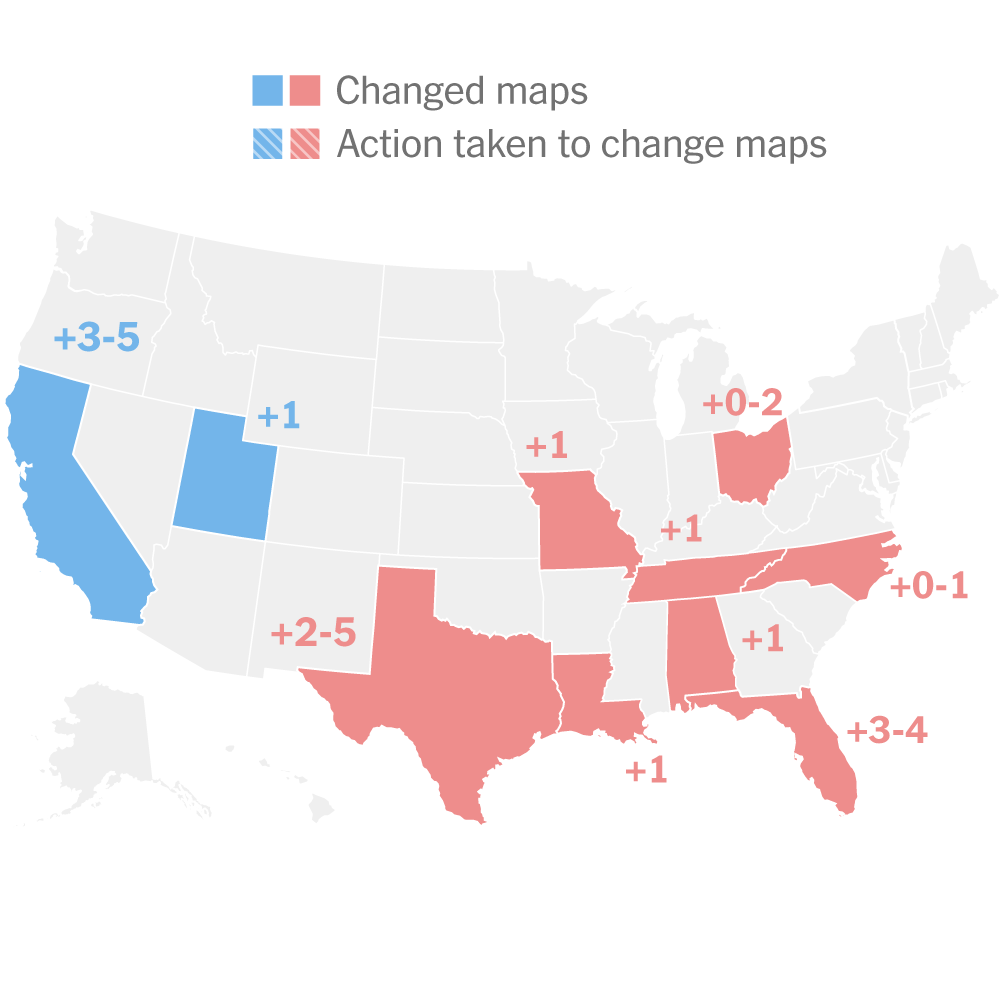
Florida’s latest political map has become a decisive victory for Republicans in the ongoing redistricting battle. The state’s newly drawn congressional districts are expected to strengthen the party’s hold on several key seats. This outcome follows a prolonged legal and political struggle that drew national attention. Democrats had hoped to challenge the map’s fairness in court, but those efforts largely failed. The final version was approved along strict party lines, with little room for compromise. As a result, Florida now serves as a clear example of how redistricting power can reshape electoral prospects.
The fight over Florida’s map was not an isolated event. It unfolded alongside similar disputes in California and Alaska, where demographic shifts and partisan interests collided. In California, a more moderate approach to redistricting produced a map that offered some competitive races. Alaska, by contrast, saw a smaller but intense battle over its single congressional seat. Together, the three states highlighted a broader national trend of partisan mapmaking. The outcomes in these states will influence control of the U.S. House in the coming election cycle.
Republicans entered the redistricting cycle with a strategic advantage in several state legislatures. Florida’s GOP leadership used that leverage to consolidate conservative-leaning areas into strongholds. The new map reduced the number of swing districts, making it harder for Democrats to gain seats. Incumbent Republicans in the state largely backed the plan, citing the need for stable representation. Critics argue the map dilutes the voting power of minority communities, a claim that has yet to be fully resolved. Legal challenges remain possible but face high hurdles in the current judicial environment.
Democrats, on the other hand, viewed the Florida map as a direct threat to their national ambitions. They argued that the process lacked transparency and favored partisan interests over community needs. Several advocacy groups joined the opposition, calling for independent redistricting commissions. Their proposals were rejected in committee, reflecting the GOP’s firm control of the state’s legislative process. While some states have moved toward nonpartisan panels, Florida’s approach remains firmly political. This divergence has created a patchwork of electoral rules across the country.
The impact of Florida’s map extends beyond individual races. It affects the national balance of power, with every seat in the House carrying weight for legislative agendas. A stronger Republican delegation from Florida could tip close votes on major policy issues. Meanwhile, the state’s growing and diverse population adds further complexity to how districts are drawn. Both parties recognize that the next census will trigger another round of redistricting battles. Each side is already preparing strategies to gain an edge in future mapmaking.
For voters, the consequences are practical and immediate. The new district lines determine which candidates appear on their ballots and which issues receive priority. Some communities find themselves split across multiple districts, weakening their collective influence. Others are grouped with far-off regions, reducing local representation. This has led to confusion among residents about who represents them and why. Public trust in the electoral system continues to waver as such disputes persist.
The broader story of this redistricting cycle is one of entrenched partisan competition. While Florida, California, and Alaska each followed distinct paths, the overall trend points to increased polarization. Legal remedies have proven slow and inconsistent, leaving many questions unanswered. Lawmakers in several states are now proposing reforms to change how districts are drawn. Yet, without bipartisan support, significant change remains unlikely. For now, the G.O.P.’s win in Florida stands as a defining moment in this ongoing political chess game.