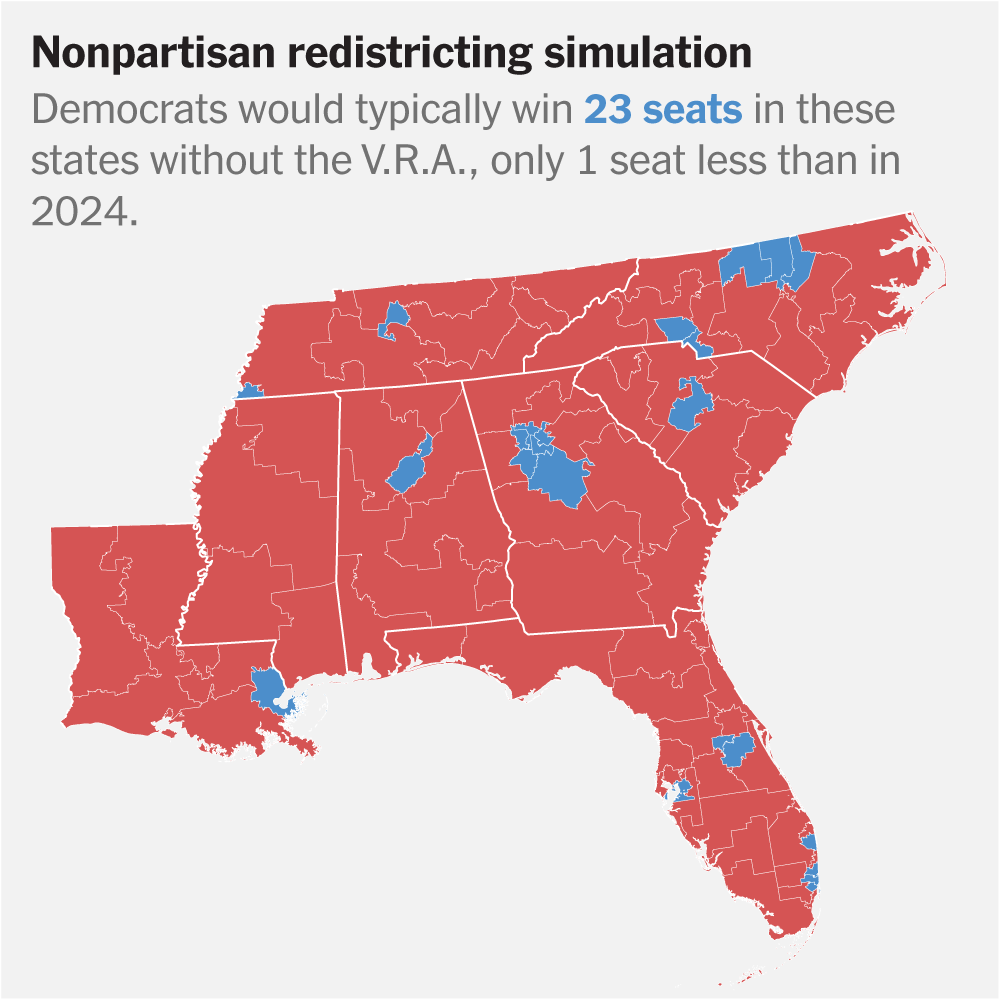
Neutral redistricting maps could provide Black voters in the South with representation comparable to what the Voting Rights Act currently guarantees. New simulations suggest that eliminating partisan gerrymandering would naturally create districts where minority populations hold significant influence.
The Voting Rights Act has long required certain states to draw districts that enable Black communities to elect preferred candidates. However, computer modeling reveals that nonpartisan map-drawing achieves similar results without those legal mandates.
Researchers ran thousands of simulations to generate alternative district maps for Southern states. The models prioritized neutral criteria like geographic compactness and population equality, ignoring partisan data.
The simulated maps produced a number of majority-Black and coalition districts nearly identical to current ones. This indicates that current minority representation stems more from natural population patterns than from the Voting Rights Act.
Partisan gerrymandering, not racial bias in map drawing, appears to be the primary barrier to fair representation. When mapmakers draw districts for political advantage, they often dilute Black voting power indirectly.
The findings challenge assumptions about the Voting Rights Act’s role in modern redistricting. If courts or legislatures could check partisan gerrymandering, minority representation might remain robust without special provisions.
The simulations highlight an intersection between racial justice and electoral reform. Neutral maps could serve both goals simultaneously, reducing the need for litigation under Section 2 of the Voting Rights Act.
These results come amid ongoing legal battles over redistricting in states like Alabama and Louisiana. The Supreme Court has recently clarified standards for racial gerrymandering, but partisan manipulation remains less regulated.
Adopting independent redistricting commissions or algorithmic map-drawing tools could achieve the same protective outcomes. This approach might also lower legal costs and reduce political conflict over district lines.